|
|
|
|
Hi friends!
|
|
Apologies for the tardy newsletter this month. I participated in May Day and spent some time making pretzels and tie dying t-shirts with my kids. Were you able to participate in May Day? Back in February, Scott Galloway suggested Resist and Unsubscribe sustained over a week or month. What do you think about this stepping up of organizers calling for boycotts of work, school, and shopping? What do you think about Resist and Unsubscribe as a way to impact markets?
|
|
|
|
|
|
Pansies and the 1920 International Freethought Congress
|
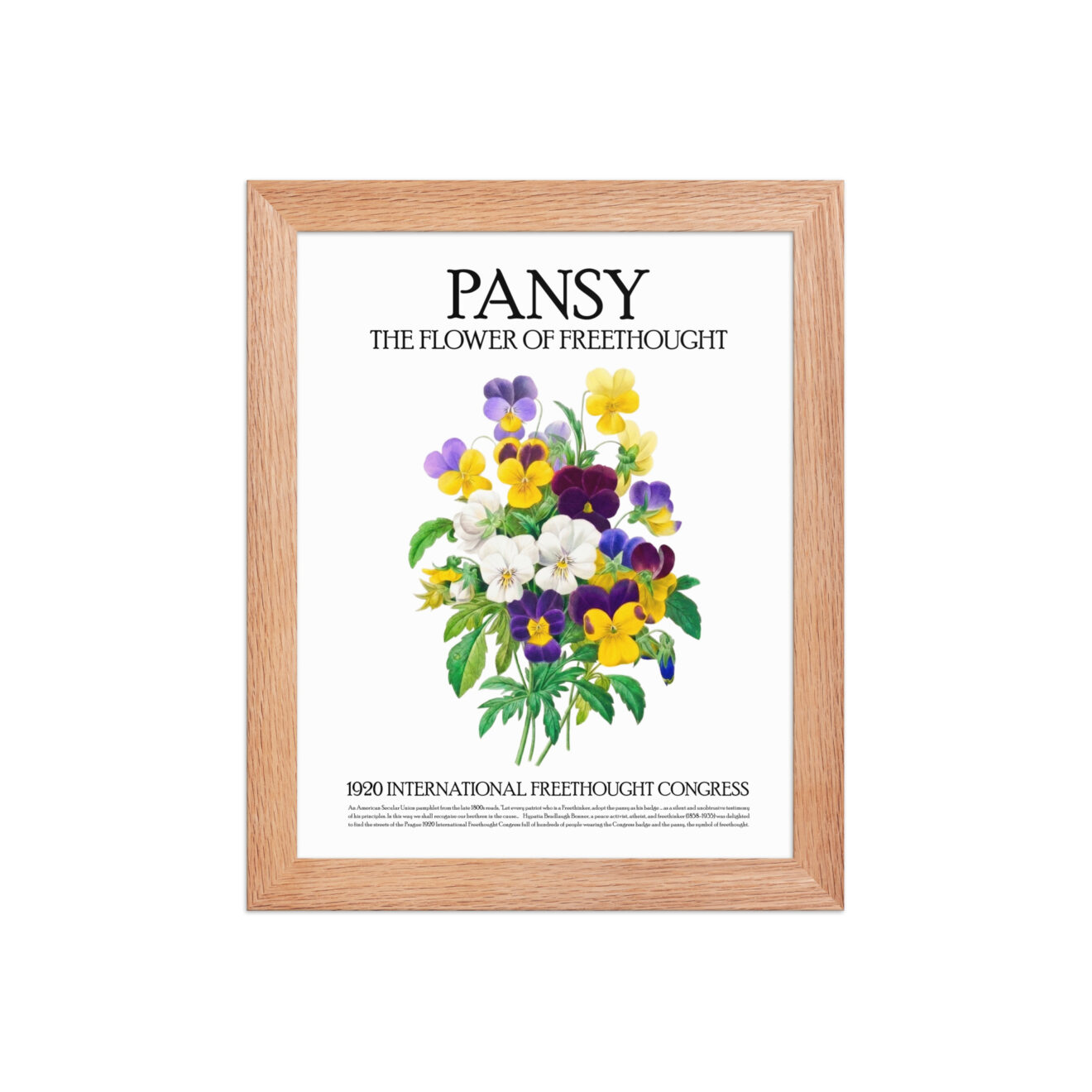
I love diving into secular history. (If you have been a subscriber for a while you have already figured that out, if not, I’m excited to tell you about it!) This month I have a new poster coming out that captures the pansy as a symbol of freethought, alongside its historical context and influence. Several things came together at the same time and I think it’s so cool to see this convergence.
|
|
The pansy emerged as a symbol of the freethought movement as a direct result of its etymology. Pansy comes from a French noun, pensée which means a thought. Freethought emerged as a term in the 1700s and a dictionary definition of a freethinker from 1913 notes, those who form opinions on the basis of reason, independent of authority, especially one who rejects or denies religious dogma.
|
|
An American Secular Union pamphlet from the late 1800s reads, "Let every patriot who is a Freethinker in this sense, adopt the pansy as his badge … as a silent and unobtrusive testimony of his principles. In this way we shall recognize our brethren in the cause…”
|
|
One vivid account of this symbol in action comes from Hypatia Bradlaugh Bonner, a peace activist, atheist, and freethinker (1858-1935). According to her writings, Hypatia was delighted when she found the streets of Prague 1920 International Freethought Congress full of hundreds of persons wearing the Congress badge and pansies, a symbol of freethought!
|
|
|
|
Pansies and the 1920 International Freethought Congress
|
I love diving into secular history. (If you have been a subscriber for a while you have already figured that out, if not, I’m excited to tell you about it!) This month I have a new poster coming out that captures the pansy as a symbol of freethought, alongside its historical context and influence. Several things came together at the same time and I think it’s so cool to see this convergence.
|
|
The pansy emerged as a symbol of the freethought movement as a direct result of its etymology. Pansy comes from a French noun, pensée which means a thought. Freethought emerged as a term in the 1700s and a dictionary definition of a freethinker from 1913 notes, those who form opinions on the basis of reason, independent of authority, especially one who rejects or denies religious dogma.
|
|
An American Secular Union pamphlet from the late 1800s reads, "Let every patriot who is a Freethinker in this sense, adopt the pansy as his badge … as a silent and unobtrusive testimony of his principles. In this way we shall recognize our brethren in the cause…”
|
|
One vivid account of this symbol in action comes from Hypatia Bradlaugh Bonner, a peace activist, atheist, and freethinker (1858-1935). According to her writings, Hypatia was delighted when she found the streets of Prague 1920 International Freethought Congress full of hundreds of persons wearing the Congress badge and pansies, a symbol of freethought!
|
|
|
|
|
Featuring an authentic 1800s botanical illustration by the Raphael of Flowers, this botanical illustration in watercolor was created by Pierre-Joseph Redouté, arguably the greatest botanical illustrator of of all time. The poster celebrates the pansy as a symbol of freethought with historical context.
|
|
|
|
|
|
|
|
|
Do you know someone who would enjoy this newsletter? Sharing is caring!
|
|
|
|
|
|
|
|
|